Time Is Not the Advantage or Constraint It Used to Be.
It’s crazy how quickly the shift is happening from “I am using AI” to “I am building agentic systems.” I don’t think most people have fully internalized how different those two ideas are. Using AI as a tool is a productivity behavior. Building agentic systems is an operating model change. It changes what intelligence is worth, what experience is worth, and what mental models individuals and companies should use to get work done.
This is not just a tooling change. It is a value and identity shift away from intelligence being the scarce thing, toward the skill of working with intelligence that is now broadly available. A lot of individuals and companies are drastically struggling with that shift, not because they are not smart, but because the thing they were rewarded for in the last era is becoming much less defensible in this one, creating arguably one of the largest change management issues humans have ever encountered.
The Compression of Digital Work
People are drastically underestimating the step function we are experiencing in the time required to complete digital work. The compression is not linear. It feels closer to logarithmic. Work that used to take weeks can take days. Work that used to take days can take hours. Work that used to take hours can now be a well-structured prompt. With well-structured agentic systems running these prompts in parallel, intelligently, on a schedule or on demand, most work can be done in exponentially less time.
That changes how you work. It changes how you compete. It changes how you organize larger groups of people. Most companies are still trying to apply old operating models to a new execution environment, and that mismatch is creating a lot of strange behavior that people are dressing up as quality, alignment, or responsible process.
Average Intelligence Is Being Commoditized
Average intelligence is being commoditized across a very broad range of subject matter expertise. That does not mean judgment no longer matters. It means baseline access to explanation, synthesis, drafting, code generation, research, and problem exploration has moved dramatically. The floor has come up fast, and many people whose value was based on being above that old floor are now having to confront a very uncomfortable reality. What is truly above-average intelligence or domain knowledge is becoming way more niche, and it has more to do with access to enough high-signal data.
At the same time, execution speed is tightening most feedback loops. That combination matters more than people realize. If you can execute faster, you can learn faster. If you can learn faster, you can improve faster. If you can improve faster, the advantage shifts away from static expertise and toward systems that create more attempts, more signal, and more useful feedback in less time.
The Defensive Reaction
This is where I see a lot of smart people reverting back to older behavior. They try to increase complexity as a way to defend against AI doing their work. They increase the number of stakeholders involved. They slow decisions down in the name of quality, taste, alignment, or company political safety. They over-index on making the work look harder, more nuanced, more process-heavy, and more dependent on human consensus. They also look to confirm their bias that the work cannot be accomplished by AI to validate their strong identity and worth being tied to the time they have already spent learning things at the speed available up to this point.
Some of that is real. Taste matters. Quality matters. Context matters. Accountability matters. But a lot of it is also defensive behavior wearing responsible clothing. It seems like people think if they make their job look harder for AI to replace, then it will prevent someone using AI from replacing the actual impact or value that the execution of their job created.
I don’t think that works. The market does not care how complex you made the process look. It cares whether the value got created faster, cheaper, and with enough quality for the job to be done at the level necessary. That is the uncomfortable truth.
Experience Was Always a Feedback Loop
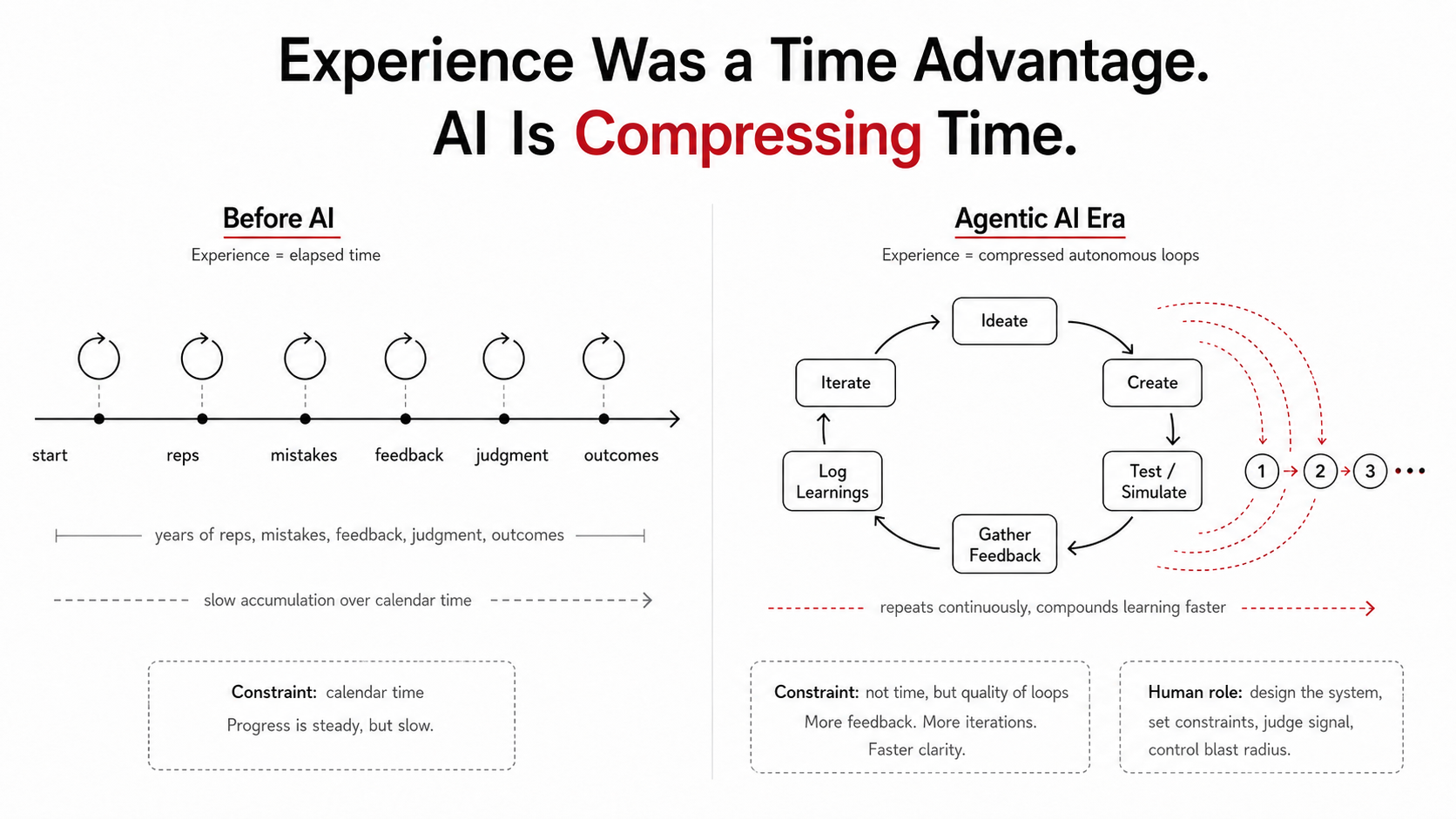
Meanwhile, another group of people is focused on a more fundamental truth: learning, whether done by a human or any other system, is a function of data, feedback loop length, signal-to-noise ratio, and time. In the past, we called this experience. Experience was shorthand for someone having more data, more reps, more mistakes, more pattern recognition, and more chances to discern signal from noise.
We trusted experience because time was the one variable we could not compress. You could not easily give someone ten years of at-bats in six months. So we used years of experience as a proxy for judgment. That proxy made sense in a world where the calendar was the constraint. The whole “nine pregnant women in a room for a month does not get you a baby” line has been a maxim for the inability to cheat time.
But AI and agentic systems are now attacking the time variable directly. The first-principles thinkers have broken this down. They are not treating experience like magic. They are treating it like accumulated feedback loops. And if experience is accumulated feedback loops, then the obvious question becomes: how do I increase the number of high-quality feedback loops I can run?
Agentic Systems Create More At-Bats
That is where agentic systems become very different from “using AI.” Using AI is asking for help. Building agentic systems is creating more at-bats. More drafts. More tests. More approaches. More simulations. More checks. More failures. More corrections. More iterations. More chances for the system to improve.
This is why I think the “AI is just a tool” framing is increasingly too small. Yes, AI is a tool in the same way software is a tool. Technically true. Strategically incomplete. The real shift is that people are starting to build systems of delegated cognition and execution that can build and run loops faster than traditional human organizations were designed to absorb.
Process Can Become Strategic Risk
The people adding process to protect quality often believe they are reducing risk. Sometimes they are. I am not arguing for reckless automation or pretending accountability, blast radius, and quality gates do not matter. I’ve written plenty about why “just let it run” is not an enterprise strategy.
But if you slow down learning too much, you may actually be increasing strategic risk. In this environment, learning speed compounds. The person or company running ten thoughtful iterations while another company is still trying to schedule the alignment meeting is not just moving faster. They are accumulating more feedback, more data, and more judgment.
They are rolling the dice more times. Even if each attempt only has a modest chance of improvement, more at-bats matter. Over enough loops, that advantage compounds in a way that is very hard for slower organizations to see until it is already too late.
The Wrong Thing to Defend
I think many people are defending the wrong thing. They are defending the appearance of expertise instead of building systems that produce better outcomes. They are defending process instead of feedback loops. They are defending time served instead of learning rate.
That is a dangerous trade. The next era of knowledge work will not reward people simply because they are smart, credentialed, or experienced in the old sense. It will reward people who can reason from first principles, break work into loops, use agents to increase the number of useful attempts, validate aggressively, and compound learning faster than the people around them.
The New Scarce Skill
The scarce skill is no longer just knowing the answer. It is the ability to build a system that can find, test, validate, and improve the answer faster than before. That is the identity shift people are struggling with, because it changes the basis of personal and organizational value.
Once you see that clearly, a lot of current behavior starts to look very different. Some people are learning the new game. Some people are trying to make the old game look harder to automate.
I don’t think the second group is going to like how this plays out.